






Multi-Agent Systems (MAS) refer to computing systems composed of intelligent agents acting together to attain individual or group goals. Multi-agent systems refer to collectives of AI agents who put in their joint effort to achieve things that would be significantly too demanding for any individual AI to undertake. Start with an array of tiny digital aides, each uniquely gifted, but all cooperating in the background, socializing, and collaborating to bring results. Imagine having a panel of experts sharing a single aim, but cyber world-style. Such systems work most beautifully in operations that necessitate coordination and nimbleness, like managing traffic within a big city or scheduling relief efforts.
Key Concepts of Multi-Agent Systems
- Autonomy: Agents make decisions independently, allowing decentralized control.
- Interaction: The agents interact and coordinate to align their actions for successful collaboration.
- Decentralization: Unlike centralized systems, MAS lacks a single control point, enabling flexibility in dynamic settings.
- Flexibility: Agents can be flexible to changing dynamic environments, i.e., traffic or new delivery requests, for which MAS is well-suited for real-time optimization.
The Challenge of Last-Mile Delivery
Last-mile delivery is responsible for a large portion of logistics costs, typically as much as 50% of all transportation expenses, according to one study on Sustainable Transportation Systems in modern society. Urban settings worsen these issues because random flow patterns of vehicles in cities can cause delays in deliveries, generating more fuel expense and decreasing efficiency. E-commerce-generated volume fluctuations necessitate adaptive routing to accommodate last-minute cancellations or last-minute orders. Predefined schedule-based traditional static route optimization cannot fit such problems. Only dynamic route optimization can attain this with real-time route modifications according to prevailing conditions. GPS, AI, and machine learning solutions are widely used, but tying them to a harmonious platform is still tough
How Multi-Agent Systems Enable Dynamic Route Optimization?
Multi-Agent Systems provides a dynamic route planning by utilizing the collective intelligence of agents capable of independent decision-making and working together in real-time. In last-mile delivery, an agent can be a delivery vehicle, drone, or robot continuously gathering information from the surrounding environment via media like GPS, traffic sensors, or weather reports. Based on this information, it calculates the most effective route to its destination, considering variables such as roadblocks or the delivery timing. The factor distinguishing MAS from single optimization is that agents can easily interact with each other.
For example, when a car detects traffic development, it can broadcast this update to other vehicles, adapting their routes dynamically and avoiding delays without creating overlap between delivery areas. This communicative, distributed model enables the system to respond quickly to perturbations, a vast improvement over rigid, centralized plans where updates must cascade through a single command center. It usually occurs in layers, and each agent optimizes local activities while contributing to global goals, arriving at beautiful compromises between individual and system objectives. The reward is tangible: reduced delivery windows, reduced gallons burned, and more reliable ETAs that delight customers. Nevertheless, implementing
MAS is not without challenges. Effective coordination requires strict communication mechanisms to prevent conflicts (e.g., two agents fighting over the same route), and combining MAS with legacy logistics systems involves significant technical investment. Despite this, the payoff of faster, cleaner, and more agile deliveries makes MAS a last-mile logistics game changer.
MAS offers a substantial basis for dynamic route planning optimization by permitting several agents to cooperate in real-time. A given agent, for example, a delivery robot or a vehicle, can:
- Monitor Conditions: Employ data feeds or sensors to measure traffic, weather, or customer demands.
- Make Decisions: Decide independently on the optimal route given current conditions.
- Coordinate: Communicate with other agents to avoid conflicts, such as overlapping routes or congested areas.
Benefits of MAS in Last-Mile Delivery
Enhancements in coordination, tracking, and resource utilization in real-time with optimized routes make multi-agent systems (MAS) strategically improve last-mile delivery and dispatch. Some key benefits of multi-agent systems in last-mile delivery include :
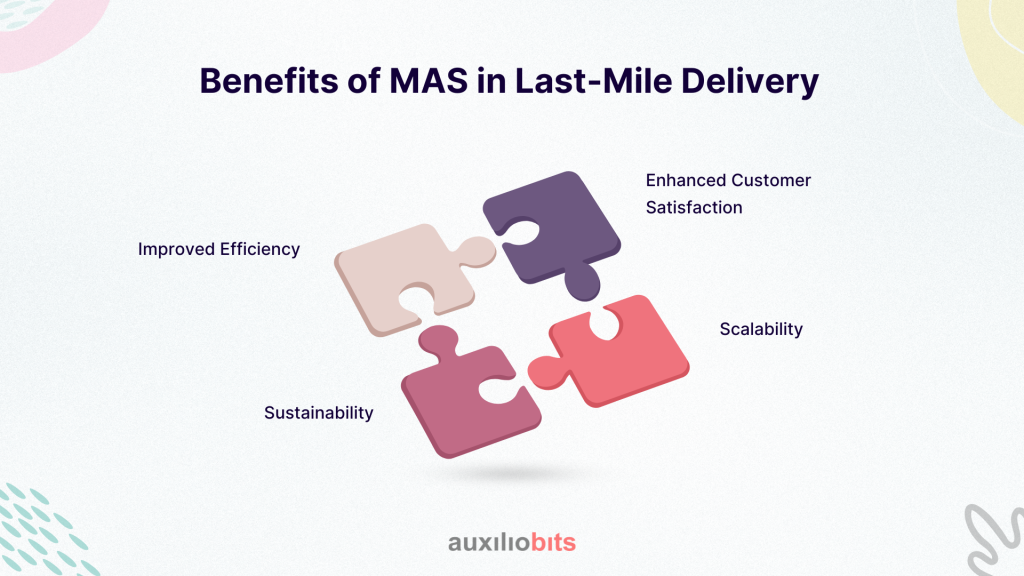
- Improved Efficiency: By optimizing the routes in real-time, MAS can reduce delivery times and fuel consumption, potentially cutting fuel costs.
- Enhanced Customer Satisfaction: Real-time tracking and accurate estimated arrival times improve transparency and reliability.
- Sustainability: Optimized routes reduce environmental impact by minimizing fuel use and emissions.
- Scalability: MAS can manage large fleets of agents, making them suitable for high-volume delivery operations.
Challenges of Implementing MAS
Challenges of MAS in last-mile delivery include communication issues, coordination complexity, scalability, infrastructure limitations, real-time data dependency, and security concerns. The following are some key challenges in last-mile delivery:
- Coordination Complexity: Ensuring all agents work toward a common goal without conflicts requires sophisticated communication protocols.
- System Integration: Integrating MAS with existing logistics software and hardware can be technically demanding.
- Security and Trust: Ensuring agents are secure and trustworthy is critical to prevent system failures or malicious interference.
Conclusion
Multi-Agent Systems (MAS) lead the way in reinventing last-mile delivery, addressing its intrinsic challenges with distributed, adaptive solutions. MAS directly confronts urban traffic congestion, demand fluctuations, and sustainability by equipping agents to coordinate in real time. Their wider uses, from fleet optimization to predictive analysis, point towards a future in which logistics is quicker, cleaner, and more customer-focused. With research fueling innovations in AI, sustainability, and optimization, MASs are the key to making last-mile delivery a seamless, efficient lifeline for the e-commerce era.